
They dribble when they should pass. They pass, and we lose the ball.
You have probably seen both in the same session.
A player has the ball and a teammate close by. They keep dribbling until the defender closes them down and takes it. The next time, they pass at once. The teammate receives under pressure and loses the ball.
"We need to move the ball better."
"You held it too long."
Both comments describe what we saw. Neither explains why it happened.
Most of us were taught a rule for this: pass if you can, dribble if you can't. It sounds reasonable, and it is wrong more often than it looks. In the second mistake the pass was available. The player followed the rule, and we still lost the ball. Why? The defender was not pressing the possessor. They were protecting the teammate, staying between the two attackers. The pass was open, but the advantage was not there yet.
This is the problem of Pass or Dribble. Not two techniques to choose between, but a question the possessor has to answer before choosing: does the advantage already exist, or do I have to create it?
What the possessor is trying to do
Pass or Dribble is a Principle for the possessor, the player with the ball. The intention is to create or use an advantage, for themselves or for a teammate. A pass can give a teammate the space and time to control forward. A dribble can make a defender leave the space they were protecting, or beat the defender when the situation offers a 1v1.
Two intentions organize the Principle: pass to progress and dribble to commit. To commit a defender is to make them engage with the possessor, so that what they were protecting is no longer protected. These two intentions are not everything a pass or a dribble can do in the game, but they are what makes the examples in this chapter readable.
And sometimes neither creates an advantage. Then the intention is to maintain or protect the ball until the attack can restart. The Principle does not oblige the possessor to go forward on every possession.
Three relationships
Put a 2v1 on the board: possessor, near receiver, one defender. Everything the possessor has to read is in three relationships.
The possessor and the defender.
Is the defender pressing the ball, or protecting the passing option? Are they close enough to challenge? Are they moving forward, standing, or dropping? Is their body facing the possessor, or side-on and ready to turn?
Read behavior and distance together. A defender running at the ball may leave the teammate free. A defender protecting the teammate may leave space in front of the possessor. But "not pressing" is not the same as "room to dribble". A defender can be close enough to deny the pass without ever pressing. Body orientation and movement tell you what the defender can do next: a frontal defender needs a bigger turn to recover, a side-on defender changes direction more easily.
For the coach, it helps to think of the direction and momentum of the defender's movement as their flow. With the player, a simpler question is normally enough:
Is the defender moving toward the ball or toward your teammate?
The possessor and the teammate.
A teammate nearby does not make the pass useful. Can the ball reach them? And what will they be able to do when it arrives?
A free player does not have to be completely unmarked. They need enough space and time to receive without immediate pressure and continue advancing. That is the difference between unmarked and free. A teammate can look free now and receive too late to go forward, because of where they are standing, how their body is oriented, or how fast the defender recovers.
Their movement matters too. Where do they want to go, and what are they trying to do with that movement? The possessor is connecting with a player who has an intention, not sending the ball to a spot on the pitch.
Both attackers against the defender.
Now put the two together and ask the question that matters. Who has the advantage right now? If I'm the possessor: can I use it, or do I have to change the situation first?
Three situations
Same 2v1, three different game states. They are examples of how the information interacts, not three answers to memorize.
1. The defender presses at speed, and the teammate is free.
The defender runs at the possessor. The teammate, away from that run, has space and time to receive and control forward. The pass uses an advantage that already exists. As the ball travels away from the press, the defender has to slow down, turn and recover, and the receiver uses that time.
The condition is double. Not only that the defender presses, but that the teammate can continue. If they can't, the pass just moves the problem to another player.
2. The defender protects, and there is space to dribble.
The defender stays between the two attackers and protects the passing option. Pass now and the defender keeps defending the receiver. Nothing has changed.
The possessor has space in front. Dribbling into it puts the defender in a dilemma: keep protecting, or come to the ball. When the defender steps or shifts toward the possessor, the passing option opens. The possessor keeps reading both players while dribbling. The step matters because of what it opens, and the receiver still has to be able to control forward when the ball arrives.
3. The defender is close, and the pass is hard.
There may be no room to dribble to attract. The defender is already near, and the passing option is difficult.
Now body orientation and movement decide. A frontal defender who stands still instead of dropping, or who steps forward, may be offering a 1v1. That is an opportunity to recognize, not an order to dribble every time the defender faces you.
The receiver can change the situation too. A diagonal run across the space may open a vertical pass. The direction of the run and the direction of the ball do not have to match.
So the possessor keeps both relationships alive: what the defender allows, and what the teammate's movement makes possible.
Correcting the player
Go back to the two mistakes from the start. Before saying anything, ask two questions, in this order.
Could the chosen action generate an advantage?
Did the execution make that advantage possible?
A player can read a good passing opportunity and deliver the ball badly. Another can complete a pass that leaves the teammate with a problem. Those are different mistakes, and they need different corrections. If we only look at whether we lost the ball, we correct the wrong one.
The decision first.
The player dribbled and lost the ball. Before telling them to pass, look at the defender.
- What were they doing?
- Were they protecting the passing option, or did their movement open it?
- And if the pass was open, could the teammate receive it and go forward?
- Did the teammate move? And where: toward the ball, or across the space behind the defender?
That movement can open a pass that was not there a second before.
The player passed and the teammate lost the ball. Before blaming the pass, ask whether the teammate had the conditions to continue at the moment the decision was made.
The result helps us investigate. It does not explain the decision on its own.
Then the execution.
Once the decision makes sense, look at how the action was performed.
A pass that helps the receiver.
The pass is there to facilitate the receiver's next action.
Its weight, speed and direction decide what the teammate can do with it. A ball played behind the receiver forces an adjustment, and that adjustment gives the defender time to recover. A pass into space has to meet the teammate's run. So ask where the teammate wants to go and what they want to do there, and then whether the delivery serves that.
This is also how to think about diagonal and vertical passes. A diagonal pass normally gives the receiver a more comfortable body orientation to control forward, and forces a harder turn on the defender. But the diagonal is not always available, and not always better. A vertical pass can create the bigger advantage, including when the receiver's diagonal run is what opens it. Compare what each option demands from both players: how hard the pass is to execute, and how hard the control is. A pass into space can be harder precisely because it has to be coordinated with the movement.
A dribble that influences while you can still see.
The direction, rhythm and speed of the dribble serve its purpose.
A controlled advance is often enough to make a protecting defender step. A 1v1 opportunity may call for speed. Either way, the speed has to influence the defender while still allowing the possessor to perceive what is happening. If the player can no longer read the defender or the teammate, they will not recognize the next opportunity. That is not "always dribble slowly". It is relating speed to the situation and to what the player can still see.
Many players dribble fast because they feel under pressure, not because they are. Feeling under pressure and being under pressure are not the same thing, and the first one rushes decisions more than the second.
Direction matters too. In a 2v1, dribbling into the space away from the teammate keeps the two attackers from ending up in the same space, and keeps the passing advantage alive. The question for the player can stay concrete:
"Is there a space you can enter that makes the defender choose between pressing and staying?"
Coaching while the game continues
Keep the intervention connected to what the player has to recognize.
| When your correction would be… | Try directing attention with… |
|---|---|
| "Pass!" | "Can your teammate receive and go forward?" |
| "Dribble!" | "Is the defender protecting or pressing?" |
| "You held it too long!" | "Who was the defender watching?" |
One intervention, the relevant one, and leave the player room to act. Longer questions can wait for a natural break or the end of the activity.
The aim is to help the player connect what they saw with what they chose. The questions should not become a new script of answers to follow.
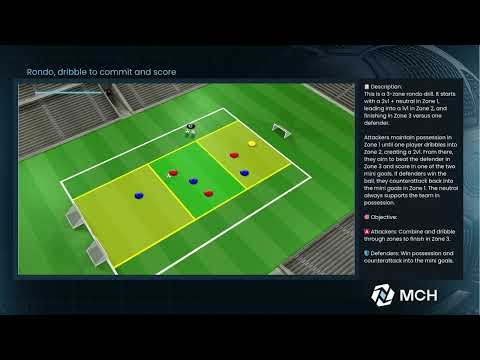
Try this: three-zone rondo
- Setup
- Three zones in a row. In Zone 1, two attackers and a neutral against one defender. In Zone 2, one defender. In Zone 3, one defender and two mini goals. Two more mini goals sit at the back of Zone 1, facing the defenders.
- How it plays
- The attackers keep the ball in Zone 1 until one of them dribbles into Zone 2. There they face the defender in a 1v1, or a 2v1 if the teammate follows. From Zone 2 they attack Zone 3 and try to beat the last defender and score in one of the two mini goals. If the defenders win the ball at any point, they counterattack into the mini goals in Zone 1. The neutral always plays with the team in possession.
- Objective
- Attackers: combine and dribble through the zones to finish in Zone 3. Defenders: win the ball and counterattack.
- Where the Principle appears
- Twice. In Zone 1, when the possessor has to decide whether the defender is protecting the pass or coming to the ball, and whether the moment to dribble into Zone 2 has arrived. And in Zone 2, if the teammate follows: a 2v1 against one defender, the same relationship as the three situations above.
- Video
-
After the activity, go back to the two questions. The decision first. Then whether the pass or the dribble was executed in a way that made the advantage possible.
Pass or Dribble — at a glance
The question the possessor has to answer: does the advantage already exist, or do I have to create it?
| Relationship | What to read |
|---|---|
| Possessor and defender | Pressing the ball, or protecting the pass? Distance. Body orientation and movement. |
| Possessor and teammate | Can the ball reach them? Can they receive and go forward, not just receive? Where are they moving? |
| Both attackers against the defender | Who is free right now, you or your teammate? |
| What the defender does | What it can open | Possible response, when its conditions are there |
|---|---|---|
| Runs at the possessor | A teammate away from the run, with space and time to go forward | Pass, against the defender's movement |
| Protects the passing option | Space in front of the possessor | Dribble until the defender has to choose, then release |
| Stays close, frontal, still or stepping forward | A 1v1, or a vertical pass opened by the teammate's diagonal run | Beat the defender, or play the pass the run opened |
| Nothing opens | Nothing yet | Keep the ball until the attack can restart |
| Correcting the player | Ask |
|---|---|
| The decision | Could the chosen action generate an advantage? |
| The execution | Did the execution make that advantage possible? |
A lost ball on its own answers neither.